Wednesday, February 27, 2013

How Should the United States Respond to Iran's Nuclear Program?


While there does not seem to be an immediate danger of the United States taking military action against Iran over the development of their nuclear program, there are people who argue for it, either to stop the program from succeeding, or to remove the program if and when the program succeeds in producing nuclear armaments. However, this would not be sufficient cause for an attack, and would in all likelihood just end up doing more harm to the United States.


Current Progress of Iran's Nuclear Program          

The sanctions against Iran do slow down their production of enriched uranium, yes, and do have a significant impact on its economy. Ultimately, however, Iran will gain the capability to produce a nuclear weapon. Even with the sanctions Iran has recently been able to increase the speed at which it is progressing.

Iran's President, Mahmoud Ahmadinejad, tours a facility housing centrifuges used to enrich uranium.


 Sufficient Cause for Attack

What we do after they reach the ability to make a nuclear weapon should depend on what they do next. The capability to do something does not necessarily imply the intention to do something. Would more nuclear weapons among the countries of the world be a bad thing? Yes. That does not mean we should attack them, though. The ideal situation would be to rebuild diplomatic ties and solve our problems with civility and respect.

A discussion on diplomacy with Iran from PBS NewsHour

In any instance where one option is to cause harm to other human beings, that should be the absolute last resort. That is not saying that we should allow Iran to bomb us before we make a move, but the United States should not attack another nation until it has made actual overtures of violence against us. International Humanitarian Law does not specifically dictate that it is illegal to attack, but refraining from making the first strike follows the intent of the law and the interest of preserving peace.


Change in U.S. Outlook on War            

Historically, it the U.S. has done best in wars that it did not instigate, wars which were joined because of attacks against the country or to assist allies in wars that have to potential to involve the U.S. Most of the wars prior to the Korean War fall under these criteria, and the U.S. came out ahead in all of them.
It was with the Cold War that this changed. The U.S. began to enter conflicts with the justification of maintaining liberty, partially succeeding by that standard in Korea and failing in Vietnam. In even more recent years, with current and past conflicts in the Middle East, the U.S. has engaged in conflict in order to prevent potential attacks against the country, which has resulted in protracted conflict with dubious gains. A war with Iran would likely follow the same pattern.

I am of the opinion that peaceful prevention of a conflict is the best way to come out ahead. Even if Iran is hostile in character, until it becomes hostile in action there are still other options.
Violence should only ever be used as a last resort.

Tuesday, February 26, 2013

Evaluating U.S. Foreign Policy Towards the Middle East

At a time when tensions in the Middle East continue to increase, we would like to ensure that BYU students can have access to reliable and accurate information regarding significant controversies surrounding U.S. Middle Eastern Foreign Policy. We invite you to follow our blog as we explore three current issues: the legality of U.S. drone strikes in Pakistan, U.S. involvement in the Israeli-Palestinian conflict, and how the U.S. should react to Iran's push for nuclear power. 

These issues are all related in terms of the question: To what extent should the U.S. be involved in these Middle Eastern issues? Considering the fact that previous U.S. foreign policy in recent decades has contributed some of the issues and tensions in the Middle East, it is important to evaluate whether the U.S. should attempt to help resolve some of the issues we exacerbated or hope that a withdrawal of involvement would lessen the tensions and improve international relations.


The U.S. previously funded the Taliban to fight against the Soviet Union 
Join us on this blog as we examine different implications and considerations of the following questions:

  • Does the U.S. have the right to send unmanned drones into Pakistan? Are these actions legal in terms of U.S. domestic law and the international law that applies to the conflict?
  • Should the U.S. support an increasingly aggressive Israel or support Palestine? Or should the U.S. let the nations resolve their conflicts without interference?
  • How should U.S. respond to Iran's actions? Are sanctions effective? Or should a military response be pursued? Does the U.S. even need to take any action regarding Iran?

It is important to note that the cultural and political history of the Middle East is very complex and difficult to understand, and we are by no means experts on this topic. As such, we will do our best to research carefully and impartially. However, it would be impossible to learn and in turn present the intricacies of the various situations in the Middle East in full.

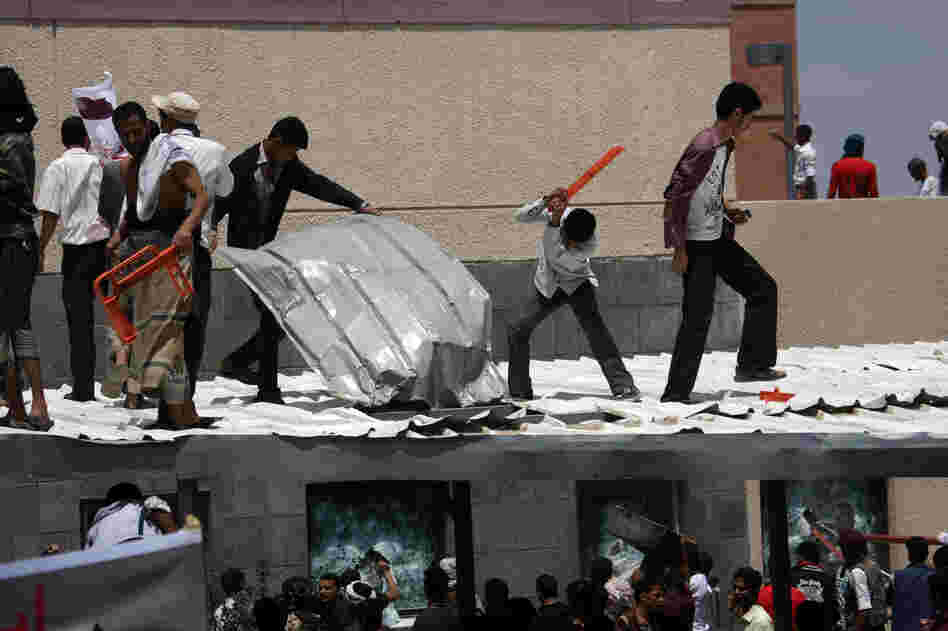
We would also ask readers to remember that the Middle East, as is the case in the United States, has people from across all spectra, including violent extremists and peaceful, sympathetic human beings. A recent example is the response to an anti-Islam film. As many of you probably recall, this film led to violent outbursts targeting the U.S.


Protesters attack the U.S. embassy in Yemen
However, there were other, less reported, responses as well. This included groups of Libyans showing support for the U.S. after a terrorist attack destroyed the consulate and killed an ambassador.

A Libyan man apologizes for the actions of violent Muslims 
As this example illustrates, there are different interpretations of and reactions to every situation, and an accurate viewpoint on a foreign policy controversy in the Middle East cannot be based on one assumption. Thus, as we explore these issues, we will try to express views based on comprehensive and balanced information, and we hope that our readers will also be open to new interpretations.

Wednesday, February 20, 2013

The Role of the United States in the Israeli-Palestinian Settlement Dispute


Israeli Settlements in Palestine

As of the end of last month, around 520,000 Israelis live in settlements on Palestinian soil. 
The Israeli settlement of Modi'in Illit


Additionally, Israeli Prime Minister Benjamin Netanyahu has reaffirmed that more settlements would be built. This statement was delivered soon after Palestinians protesting the planned construction were forcibly evicted by Israeli soldiers. 


These settlements also have opposition abroad, such as the recent UN investigation that declared the building of homes for Israelis in Palestine illegal, and suggested that it could be considered a war crime. Despite the generally negative reaction to Israel's recent actions, the United States remains a stalwart ally of Israel, a stance that I feel is increasingly illogical considering Israel's expansionist, uncooperative actions.

A History of  US Support


Israel, one of very few US allies and democratic nations in the Middle East, has long benefited from US support, both militarily and economically. As a result, Israel has one of the most powerful and technologically advanced militaries in the Middle East. However, rather than defend itself from neighbors as Israel once had to, it has the power to build more and more settlements in Palestine while Palestinians can do nothing but protest and request help from the international community. But as long as the US firmly backs Israel, there is, in reality, very little other nations can or will do in response to these settlements.

Policy Change


It now seems hypocritical of the US to strongly support Israel as long as they continue expanding into Palestinian territory. I would argue that the US should join the rest of the world in censuring Israel and supporting Palestinian statehood. Despite the fact that in this nation, being “hard on Israel” is generally seen as negative, I think that unless Israel ceases violating international law, it is exactly the stance the US must take. Although little military action has been involved, Israel has still taken over land that was, as decided by the UN many decades ago, part of Palestine. From some other nation, this type of behavior would be (and has been) seen as reason to go to war, and while I do not suggest military intervention, I feel that the US is obligated as an active member of the international community to take a much sterner approach to relations with Israel as long as the Israeli government claims Palestinian land as its own.

Tuesday, February 19, 2013

Are Drone Strikes in Pakistan Legal?

In the war on terror, the use of unmanned drones has escalated, especially in Pakistan, where the U.S. is not formally at war. Though the White House Press Secretary has recently stated that these strikes are “legal”, no government authority has openly explained the legal basis for the CIA drone strikes. However, domestic and international law, when closely examined, clearly expose the true illegality of these drone strikes.

Four legal issues that arise regarding U.S. drone strikes in Pakistan are:
  1. U.S. Domestic Law
  2. Transparency & Responsibility
  3. Appropriate Targets
  4. Pakistan's Sovereignty

U.S. Domestic Law

The most commonly cited legal basis for drone strikes is the Authority for Use of Military Force (AUMF) law passed in 2001, just after 9/11. Obama and Bush have claimed that this applies not only to al-Qaeda but to any "associated forces", which the law does not explicitly state.

 Because many drone strikes are no longer targeting individuals directly involved with 9/11, AUMF should no longer be relevant. Yet even if it is applicable, not enough information is revealed to the public to prove that individuals are being identified as such terrorist suspects before assassination.

Transparency & Responsibility

The International Human Rights Law (IHRL) requires nations to be transparent in their actions and open to investigate any war crime accusations, especially when civilian casualties are concerned. However, the U.S. drone strikes in Pakistan are overseen by the CIA, not the military, and the public has been kept largely in the dark. Only recently have government officials openly acknowledged the drone war.

Appropriate Targets

According to the International Humanitarian Law (IHL), which applies to armed conflicts, factors that must be considered in determining whether use of force is appropriate in a conflict involving non-state groups, include the conflict's extent, duration, and the group's identity.

However, many 'signature strikes' occur, where the individual is unidentified and targeted only for suspicious behavior. Under the IHL, “civilian populations...shall not be the object of attack”. Regardless, there exists secondary drone strikes that target first-responders and rescuers, resulting in many civilian deaths.

Pakistan's Sovereignty
The only cases where the UN allows the use of force between two states are self-defense reasons, if approved by the Security Council, or the other state's consent. Pakistan's agreement to these strikes is doubtful. Yet self-defense is only allowed under the UN Charter in response to an armed attack or 'imminent threat'. 

Though an armed attack occurred on 9/11, al-Qaeda has been restricted enough by U.S. counter-terrorism efforts that they should no longer be termed an 'imminent threat'. Many of the drone targets are no longer influential terrorists planning attacks on Americans, but mid-level militants who are likely more concerned with their own governments. Thus, the U.S. is violating Pakistan's sovereignty through their use of drones as 'self-defense'.

After an examination of these four areas, it is evident that U.S. drone operations are not legal, with respect to domestic and international laws, and should be reevaluated. 

Friday, February 15, 2013

Iranian Hostilities?

There are people who think that the sanctions against Iran are not enough to prevent the nation from gaining the capability to create nuclear weapons, and that the United States should use military force to either prevent Iran from reaching that point or remove that capability after they reach it. However, the actions that Iran has taken do not necessitate the use of military force.

US Support of Israel

The recent vote upgrading Palestine's status in the U.N. has shown that very few countries aside from the US support Israel. However, many of Israel's recent expansionist actions, especially the building of settlements in Palestine, a move condemned by the U.N., indicate that, in my opinion, the US should take a tougher stance towards Israel as long as they keep violating international law.

Thursday, February 14, 2013

Drone strikes on American citizens?


Should the U.S. President be able to approve drone strikes on American citizens?

           Many Americans are worried about the President's ability to use secret evidence to label a U.S. citizen as a terrorist and order his execution, because the role of judge, jury and executioner becomes combined into one person. The special court that examines U.S. wiretap operations has been suggested as a model for a way to review and approve the killing with drones of U.S. citizen terrorist suspects by a U.S. court. However, even if this special court is implemented successfully, does it make drone strikes any more ethical?