These issues are all related in terms of the question: To what extent should the U.S. be involved in these Middle Eastern issues? Considering the fact that previous U.S. foreign policy in recent decades has contributed some of the issues and tensions in the Middle East, it is important to evaluate whether the U.S. should attempt to help resolve some of the issues we exacerbated or hope that a withdrawal of involvement would lessen the tensions and improve international relations.
 |
| The U.S. previously funded the Taliban to fight against the Soviet Union |
- Does the U.S. have the right to send unmanned drones into Pakistan? Are these actions legal in terms of U.S. domestic law and the international law that applies to the conflict?
- Should the U.S. support an increasingly aggressive Israel or support Palestine? Or should the U.S. let the nations resolve their conflicts without interference?
- How should U.S. respond to Iran's actions? Are sanctions effective? Or should a military response be pursued? Does the U.S. even need to take any action regarding Iran?
It is important to note that the cultural and political history of the Middle East is very complex and difficult to understand, and we are by no means experts on this topic. As such, we will do our best to research carefully and impartially. However, it would be impossible to learn and in turn present the intricacies of the various situations in the Middle East in full.
We would also ask readers to remember that the Middle East, as is the case in the United States, has people from across all spectra, including violent extremists and peaceful, sympathetic human beings. A recent example is the response to an anti-Islam film. As many of you probably recall, this film led to violent outbursts targeting the U.S.
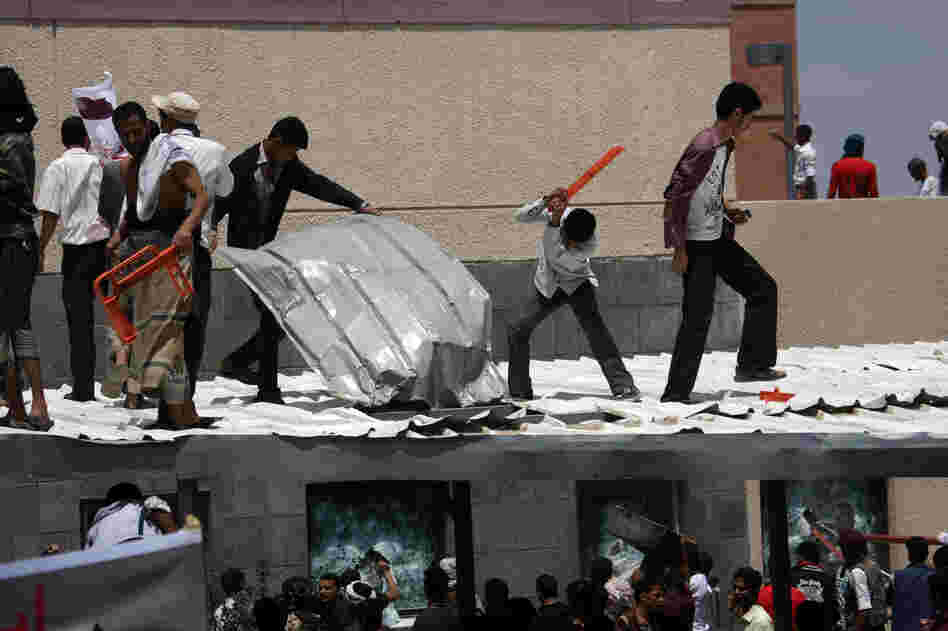 |
| Protesters attack the U.S. embassy in Yemen |
However, there were other, less reported, responses as well. This included groups of Libyans showing support for the U.S. after a terrorist attack destroyed the consulate and killed an ambassador.
 |
| A Libyan man apologizes for the actions of violent Muslims |
As this example illustrates, there are different interpretations of and reactions to every situation, and an accurate viewpoint on a foreign policy controversy in the Middle East cannot be based on one assumption. Thus, as we explore these issues, we will try to express views based on comprehensive and balanced information, and we hope that our readers will also be open to new interpretations.

No comments:
Post a Comment